
R-22, R-410A and the New Refrigerants: What Dallas Homeowners Should Know
The refrigerant inside your AC affects how it is repaired and what a replacement will use. Here is where R-22, R-410A, R-454B and R-32 stand as of 2026, in plain terms.
By the HVAC-R Finest team. Updated November 18, 2026.
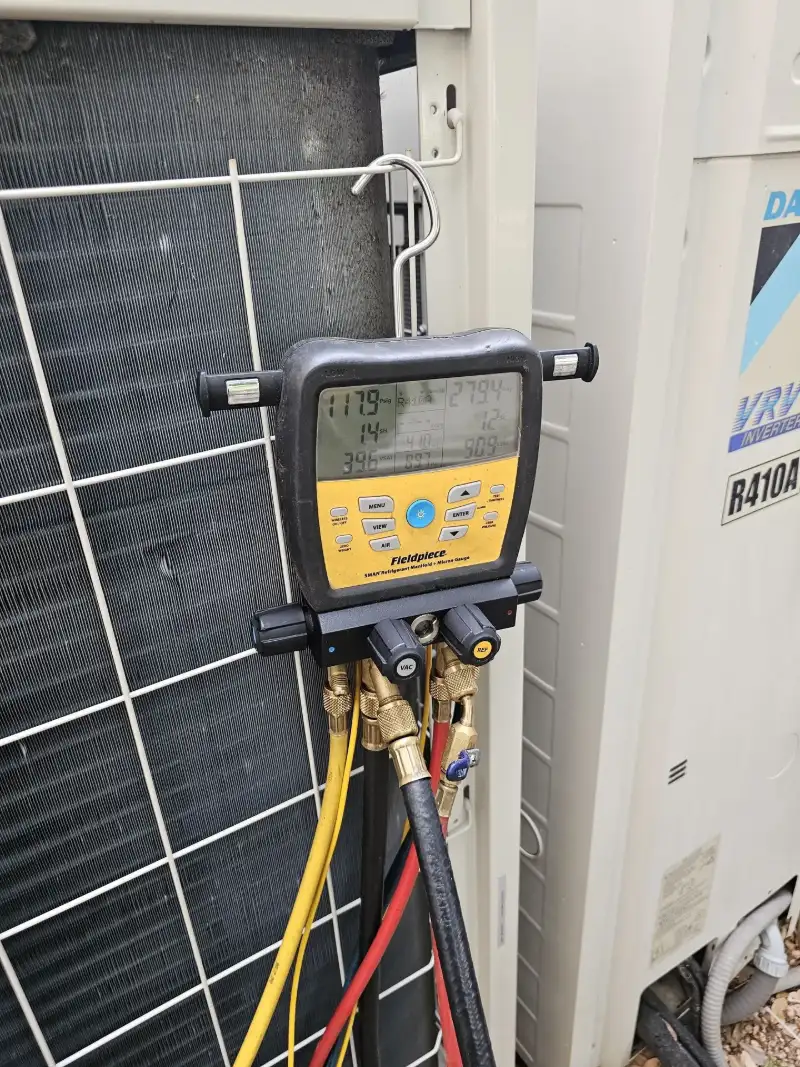
Why refrigerant rules keep changing
Refrigerant is the fluid that carries heat out of your home. For decades, most home air conditioners used R-22. It harms the ozone layer, so the U.S. phased it out. Its replacement, R-410A, does not harm the ozone layer, but it is a hydrofluorocarbon (HFC) with a high global warming potential (GWP).
In 2020, Congress passed the American Innovation and Manufacturing (AIM) Act. It directs the EPA to cut HFC production and imports by 85 percent from historic levels by 2036, in steps. It also lets the EPA restrict high-GWP HFCs in new equipment. That second part, called the Technology Transitions program, is why new home systems now use different refrigerants.
R-22: production ended in 2020
According to the EPA, no new R-22 has been made in or imported into the U.S. since January 1, 2020. Recovered and reclaimed R-22, along with supply made before 2020, is still used to service existing systems.
The EPA does not require you to replace a working R-22 system. You can keep using it and have it serviced. But the EPA is clear that there are no drop-in replacements for R-22. A system can only be converted to another refrigerant that the EPA has approved for that use, and conversion may require part changes and can affect performance. The EPA also warns that a product sold as R-22a is not R-22. It is a flammable hydrocarbon blend that is not safe for home AC systems.
R-410A: still in millions of homes, and still repairable
If your system is not an R-22 system and was installed before 2025, it most likely uses R-410A. The refrigerant type is printed on the nameplate of the outdoor unit. The EPA lists its GWP at 2,088. Starting January 1, 2025, new residential and light commercial AC and heat pump systems manufactured or imported in the U.S. must use a refrigerant with a GWP of 700 or less.
The installation deadline changed in 2026. In May 2026, the EPA finalized a rule that removed the January 1, 2026 installation deadline for systems built with components made or imported before January 1, 2025. As of 2026, that pre-2025 R-410A inventory can be installed until supply runs out.
Your existing R-410A system is not affected. The EPA says there is no requirement to stop using equipment you already have, and you can keep repairing it. Over time, though, the HFC supply keeps shrinking on schedule. EPA caps drop from 60 percent of the historic baseline for 2024 to 2028, to 30 percent for 2029 to 2033, and to 15 percent from 2036 on.
The refrigerants at a glance
GWP values below are from the EPA's Technology Transitions reference table.
R-22
Found in older systems. Ozone depleting. No new production or imports since 2020. Serviced with recovered and reclaimed supply.
R-410A
The most common refrigerant in home systems before 2025. GWP of 2,088. Existing systems can be used and repaired. Not allowed in newly manufactured home systems since 2025.
R-454B
One of the main replacements in new home split systems. GWP of 465. Classed A2L, and listed by the EPA as acceptable with use conditions.
R-32
Another common replacement. GWP of 675. Also classed A2L and listed by the EPA as acceptable with use conditions.
What A2L means and why training matters
A2L is a safety class from ASHRAE Standard 34. The A means lower toxicity. The 2L means lower flammability with a slow flame speed. So R-454B and R-32 are hard to ignite, but they are not nonflammable. That is why the EPA allows them in new home systems only with use conditions.
For technicians, this changes daily work. The Air Conditioning Contractors of America (ACCA) advises that electronic tools, gauges and test equipment be rated for flammable refrigerants. ACCA also stresses that A2Ls cannot be used as drop-in replacements in equipment built for older HFCs, and that one A2L cannot be swapped for another, such as charging an R-454B system with R-32.
Anyone who handles refrigerant must still hold an EPA Section 608 certification, and the EPA says homeowners can ask to see the card. For an A2L system, it is also fair to ask whether the technician has A2L-specific training.
Repair or replace: how to think it through
For an older R-22 system, a small repair such as a capacitor or fan motor may still make sense. A large refrigerant leak or a failed compressor is a bigger decision, because R-22 now comes only from recovered, reclaimed or older stock. The EPA recommends finding and fixing leaks instead of just topping off a leaking system, whatever the refrigerant.
For an R-410A system in good shape, AC repair is usually the first step. If the system is near the end of its life or needs a major part, compare that repair with a new system. A replacement will usually use R-454B or R-32. Because A2L equipment is not a drop-in for older refrigerants, ask which parts of the system will change, and get a clear written quote for AC installation before you decide.
Questions to ask your technician
A good technician will answer these plainly before any work starts.
- Which refrigerant does my system use?
- Where is the leak, and can it be repaired?
- Can I see your EPA Section 608 card?
- Have you had A2L refrigerant training?
- Which parts change if I replace the system?
- Is the new indoor and outdoor equipment designed to work together?
How HVAC-R Finest can help
HVAC-R Finest is a licensed HVAC contractor in DeSoto, TX, serving Dallas and nearby cities. For repairs, you approve the quote before work starts. Quotes for replacements are free.
If a new system is the right call, you can pre-qualify for financing through OPTIMUS online in under 2 minutes with no credit impact. See our financing options. You can also request same-day installation online, with availability subject to verification, parts, crew and site conditions.
More HVAC Guides
Plain answers to common heating and cooling questions from the HVAC-R Finest team.
Frequently Asked Questions
Do I have to replace my R-22 air conditioner?
No. The EPA does not require homeowners to replace working R-22 systems, and they can still be serviced with recovered and reclaimed R-22.
Can R-410A systems still be installed in 2026?
As of 2026, yes for systems built with components made or imported before January 1, 2025. An EPA rule finalized in May 2026 lets that inventory be installed until supply runs out. Newly manufactured home systems must use a refrigerant with a GWP of 700 or less.
Can I put R-454B or R-32 in my R-410A system?
No. A2L refrigerants are not drop-in replacements for equipment designed for older refrigerants.
Are A2L refrigerants safe in my home?
A2L refrigerants have lower toxicity and lower flammability. The EPA allows them in new home systems with use conditions, and trained technicians follow those requirements and the maker's instructions.
Can I still get my R-410A system repaired?
Yes. The EPA says you can keep using and repairing existing air conditioning and heat pump systems.
Not sure what your AC uses?
Call HVAC-R Finest at (972) 372-4458 and we can check your system and explain your repair and replacement options.